
Best Cutting Die is your trusted flexible rotary dies supplier for direct mail and labels. We partner with companies that need dependable cutting methods for difficult materials, offering solutions that improve your business processes, adding value while upholding quality standards.
Label converting flexible dies are steel plates with etched edges. These edges perforate, crease or cut the material as it moves through the press and across the rotary die. These dies offer numerous advantages for your operations, including:
Rotary dies are made from thin metal sheets, making them a cost-effective material-cutting option that can keep your project costs low and prevent expensive labeling issues.
High-precision flexible dies for direct mail cut materials accurately at high speeds.
These dies can cut numerous materials, like paper and foil, and accommodate window insertions, label shapes and more to meet your specific requirements.
Given the small size of flexible rotary dies, they require less floor space, leaving more room in your facility for equipment, materials and finished goods.
Many rotary dies feature chrome plating for enhanced strength and durability, maximizing performance for years to come.

At Best Cutting Die, we make converting to flexible dies even more convenient by providing customers with accurate design mock-ups and quotes within minutes.
Our flexible dies for labels are designed for label production and printing, able to support short, medium and large runs throughout their long service life. We have dies that can create perforations, micro-perforations, through-cuts and creases to process various materials used in labeling and direct mail, like:
We can also manufacture custom flexible rotary dies that are optimized to your unique processes. For example, we have specially formulated chrome plating that improves hardness and corrosion protection, as well as nonstick coatings to prevent adhesive buildup. Your die can be integrated into other processes, like laminating, embossing, coating and printing.
Regardless of your die’s specifications, our flexible rotary dies for labels and direct mail will deliver accurate and reliable cutting across various materials, maintaining tight tolerances to maximize productivity and reduce costs.
Since 1966, Best Cutting Die has become one of the leading companies in the converting industry, providing:
Learn why Best Cutting Die offers some of the most dependable and long-lasting rotary cutting dies for labels on the market. Contact us online for more information or a quote, or call 847-649-6549 to speak directly with one of our flexible die specialists.
Ultrasonic bonding uses high-frequency sound to create heat and vibration. When used for nonwoven materials, the thermoplastic fibers will bond together. Compared to other adhesive and thermal technologies, ultrasonic bonding rolls for hygiene products achieve the same effect without additives, making the nonwoven feel lightweight, soft, thin and flexible.
Our ultrasonic bonding rolls make the process of bonding nonwoven materials faster and more efficient, supporting high-speed production while creating less waste. The bonding effect is consistent and repeatable with every run, so you can yield quality results with little to no variations.
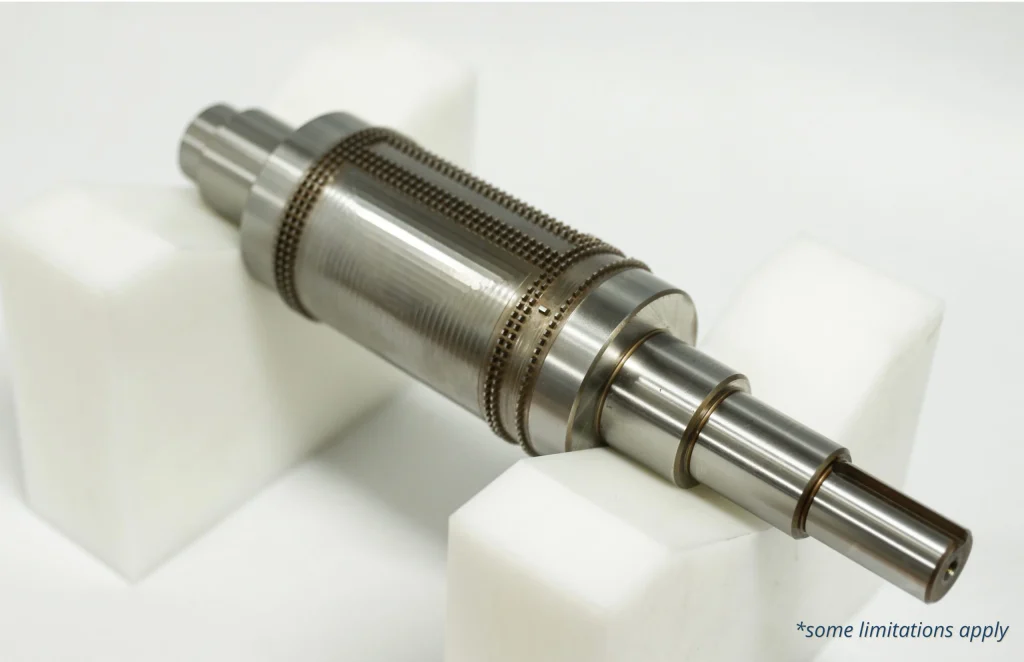
Our high-caliber flexible dies are ideal for envelope converting applications because they work with numerous envelope machines — including all F.L. Smithe and W&D models.
CNC-sharpened flexible dies produce accurate labels every time, so you can speed up your operations and improve your company’s productivity.
Our flexible dies feature optional chrome plating for increased strength and durability. The plating extends the die’s life span and is essential when cutting nonwoven items and other hard-to-cut materials.
Custom-made flexible dies from Best Cutting Die provide packaging manufacturers with maximum performance and reliable results when cutting any material.
Flexible dies are thin, precision-cut tools used for cutting, creasing, and shaping materials in the envelope converting process. They are favored for their ability to hold tight tolerances, versatility in cutting various substrates, and ease of storage due to their lightweight nature.
Flexible dies are generally more cost-effective and quicker to manufacture than solid dies. They offer faster changeovers, which can significantly reduce production downtime and increase overall productivity.
Proper maintenance of flexible dies includes regular inspection, cleaning to remove adhesive buildup. Many flexible dies come with special coatings to enhance durability and reduce maintenance frequency.
Yes, flexible dies can be customized to fit specific envelope converting machines. It is essential to provide precise machine specifications and material details to the die manufacturer to ensure optimal performance and compatibility.
Common issues include adhesive buildup on the die, improper alignment, and wear and tear. These can be resolved by using adhesive-repellent coatings, ensuring accurate setup and alignment during installation, and regular maintenance.
Flexible dies provide precise cuts and consistent quality, essential for high-volume production. Their ability to handle intricate designs and maintain tight tolerances ensures that the final product meets high-quality standards.
Many manufacturers offer field training and support to ensure proper setup, maintenance, and troubleshooting of flexible dies. This training helps maximize productivity and efficiency while reducing the likelihood of production issues.